(In process of being edited 4/7/2011)
This page is split roughly into these sections:
- What you need
- Formula
- Feeding (long section, lots of parts)
- Videos
From birth until about 4 weeks or so, kittens are dependent on liquid nutrition. Normally, that would be mother’s milk, but sometimes kittens are abandoned, mothers do dry up for a variety of reasons, or you may find yourself with a kitten who is dependent on you for her nutritional needs.
You will need several things to formula feed an infant kitten:
- Bottle or syringe
- Formula
- Paper towel or toilet paper for pottying
- An alarm clock
- Patience
Optional but recommended:
- Digital scale that weighs in grams (you really want the level of detail you get using grams, when weighing an infant kitten. Ounces aren’t fine-grained enough for keeping track. That said, if that’s all you have, it’s probably better than nothing.)
- Spreadsheet or chart to record information
- Towels
First, NEVER feed a kitten cow’s milk or cream. They lack the enzymes to properly digest uncultured cow milk, and you will make them very, very sick, and probably kill them if you don’t get them off of it quickly. You have two choices:
- Buy kitten formula (powdered or premixed) from a pet store, vet, or grocery store. KMR is the most common one, but there are others.
- Make your own using a tried and true recipe.
 I make my own. I keep a bit of KMR on hand in case I have a kitten who shows up on my door and I can’t get to the store for the ingredients, but mostly, I always use my tried and true (and vet-approved!) goat’s milk based formula. It is WAY less expensive, WAY more calorie-laden (very good for tiny kittens), incredibly easy to make, and has saved kittens I was on the brink of losing more than once. I was actually losing a kitten when I decided to give this recipe a try for the first time, and it made all the difference. Since then I cleared it with my vet, and she’s sent people to me multiple times for the recipe.
Goat’s milk kitten recipe (based originally from http://leerburg.com/bottlefeeding.htm which is a puppy bottle-feeding website):
- 10 oz. (1 1/4 cup) of goat’s milk (My local Lucky has it, but Trader Joe’s also has it.) Alternately, there may be evaporated goat’s milk near the evaporated cow’s milk. You can mix 10 oz of that with 3 oz of water instead.
- 1 egg yolk (I prefer organic, as I think it’s easier on their tiny tummies, but it probably isn’t critical. Actually, we have chickens, so I use our own eggs, but you get the idea.)
- 1 cup of plain whole (NOT low or non-fat) yogurt. They NEED the fat, don’t make a mistake with this! The yogurt can be cow’s milk-based. I’ve made this with greek yogurt, or cream top (be sure to stir it up first!), and whether the yogurt is thick, or soupy, it doesn’t much matter. Again, organic is nice, but not required. But do double check that it is both plain, and whole fat.
- 1-2 tsp light Karo syrup. If you have a new kitten, and you don’t know when they last ate, use 2 tsp in the first batch of formula. Once they’re settled in, and you make the formula again, 1 tsp is enough. (Honestly, I give a squeeze out of the bottle at this point, and don’t bother getting my measuring spoons sticky. They need it for their blood sugar, but it’s not a fussy measurement.) Do NOT use honey! Honey can carry botulism spores which they will not be able to fight, much like human infants.* If you can’t find corn syrup (I don’t know why you wouldn’t be able to – it’s EVERYWHERE, and certainly in most baking aisles) you can make a syrup up with sugar and water. Look on the ‘net for “corn syrup substitutes”
*Actually, to be more accurate, the problem with honey is that infant stomach linings allow for larger molecules to pass through to the blood stream, which allows for botulism to pass through. After weaning, the stomach lining changes, botulism can no longer be absorbed through the stomach lining, and will pass into the small intestine. Then the intestinal tract can take care of the botulism. That’s almost certainly unnecessary information: just don’t use honey. You can thank my physiology teacher for that bit of fascinating info.
That’s it! Stir it up well with a whisk, but try not to get it TOO frothy, especially if you’re going to feed it right away – you don’t want to fill your infant with air bubbles. Put this in a closed container, refrigerate it, and keep it no longer than a week. This fits pretty well into a normal sized water bottle, which also has a handy cap.
So now you have the food, how do you get it in the little tyke? This can be trickier than you’d think, until they get the hang of it. If you’re lucky, you’ll get a kitten who is hungry, and instantly latches on and gulps it down. Good on you, mate! Don’t count on that working at the 4 am feeding – I’m just saying! So what do you need to know to feed an infant kitten?
- Food temperature
- Bottle vs. Syringe
- Position for Feeding
- Amount
- Frequency
- Pottying
- Tracking Progress
- What to watch for/be careful of
- Aftercare
Food Temperature: Babies are tiny, and have a hard time maintaining their temperature through too many external or internal shifts in temperature, so you ideally want the formula to be pretty close to their body temperature (like mama’s milk would be.) Because I do this all the time, I have an automatic warmer for water, and I let the bottle sit in there for a short time, usually while I potty the baby before feeding. Never microwave the formula – you can get hot spots. Always check it against your own skin before feeding the baby. It should be warm to the touch, but not at all hot. If you can hardly feel it at all, it’s JUST shy of warm enough. Use some common sense here. You don’t want to chill the baby, nor burn her.
Bottle vs. Syringe
- Bottle:
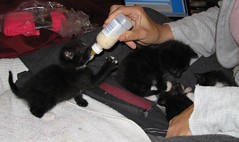
If this is your first time, chances are you’ve already picked up one of those little nursing kits at the grocery store, pet store, or vet’s office. They come with a small plastic bottle, and a whole bunch of rubber nipples for different animals. These can and do work great, although you really have to be conscious about the type and size hole you make in the tip of the nipple. If you choose the bottle, make sure you start small with the hole, because you can always make it bigger, but you can never make it smaller. And a too-big hole can be dangerous. At my vet’s, they heat up a hypodermic needle and burn a nice round hole or two in the end, and that works great.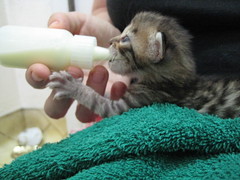 At home, I usually just cut a small X in the tip (which is usually what the instructions say to do anyway) and then check to see what the flow is like. You don’t want more than a very slow drip if you hold it upside down, but you do want it to flow easily with some pressure on the bottle. That’s what will make it safest for the kitten (no accidental inhaling of formula) and easy flow when she latches on and sucks. In the last year or so, I’ve given up on the nipples entirely, and just use the plastic tops I get that come with the 15 ml and 30 ml bottles I get from my vet. I find they have the perfect flow, they are easy to manipulate into a stubborn kitten’s mouth, and I don’t lose them when the kittens get older and try to steal them and run away!
 - Syringe:
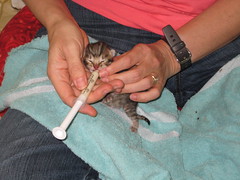 Personally, for really tiny kittens, I always use a syringe. I have WAY more control if I need to help get the food in the kitten (just the tiniest bit of back pressure, and make sure she’s swallowing.) Also, I can tell exactly how much food the kitten is taking in, and in those first few days, this is really important. I also have found that the oral syringes have a tip shape that most kittens can latch onto easily, without it sliding out of their mouths while they figure it out. I usually start out with a 3 ml oral syringe.
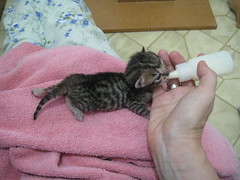
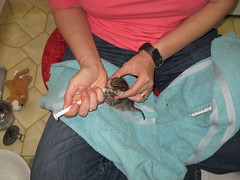 Position for Feeding: For tiny infants, you definitely want to make sure that they are belly down, with their heads upright, or even tilted up a little, paws typically outstretched in front of them. You will definitely have to help them position their tiny heads in relation to the nipple. I tend to cup their chin with the little finger of the hand holding the bottle. I sometimes also use my other hand to help steady their head until they get latched. When they get bigger (definitely not before their eyes are open) they sometimes get their own ideas, and then, all bets may be off. You are trying to simulate their natural feeding position, and also trying to avoid the baby aspirating fluids into their lungs. They can’t cough it back out like we can, so it’s a real pneumonia danger for them to do that. If they get a solid latch, you don’t have to worry at all – it’s only going down one way.
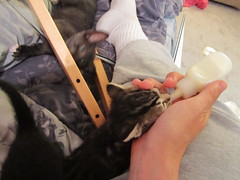 If you see formula coming out their nose and/or bubbles, it’s not good – and it’s either going in too fast, or they’re getting some in the nasal passages. Stop, hold the kitten, gently, head pointing down, and tap lightly but firmly on the back, and hopefully anything that trickled into the lungs will come out. If I’m really worried that happened, I’ll usually put my mouth over their muzzle, and give a quick and gentle suck, too. But that’s me.
Amount to feed: On average, a newborn kitten weighs 100-120g and should receive about 25-40 cc of formula per day for the first week or so of life. This should be ramping up throughout the week, and the kitten should take about 50-70 cc per day the second week, and 80-100 per day the third week. What is most important is to watch how the kitten is doing. Different kittens will take different amounts, and that’s okay – as long as they are steadily gaining, on average.
Frequency:  Kittens during their first week of life should be fed every 2-3 hours, around the clock. Yeah, the whole way around the clock.
That’s the official advice for infant kittens. Some kittens won’t eat well at that frequency, even at the newborn stage, and may need a little longer between feeds in order to have enough interest to really get a good meal. If you have one of those, who isn’t that interested unless you wait for 3-4 hours, then follow her lead. But she still needs to eat the same amount per day, so pay attention!
If they’re going strong, then the second week you can probably stretch the night feeds to 3-4 hours between feedings, as long as you do the day feedings 2-3 hours. And never stretch it that long if they aren’t taking in enough throughout the day, or aren’t gaining weight. Again, if you have one of those kittens who prefer longer stretches, go with it, and lucky you! By the time they are three weeks old, you can usually get away with one middle of the night feed, and 4-5 feedings throughout the day.
Pottying: I usually potty the kitten before I feed, and then again after. That way I rarely get pee or pooped on by surprise. That said, remember I recommended towels? Yeah – they’ll always surprise you at one time or another (the towel is to protect you – not for the actual pottying!) Pottying is really pretty simple. I usually tear paper towels into quarters before I even get the kitten out of the box. When I have the kitten, I hold her, dip a corner of the paper towel into some warm water (or, actually, just give it a quick lick), and then firmly rub/stimulate her bottom until she starts peeing freely. With a bit of experience you can tell a lot from the color of the pee, and how much it soaks the paper towel (or toilet paper.) Ideally it’s pretty light or clear. If it’s very dark, it’s very concentrated, and you may have a baby who is getting dehydrated or having other issues. You want to make sure she’s pooping regularly, too, so don’t forget to stimulate her rear end, too.
Tracking Progress: I will tell you right now, if you don’t keep records and track the kitten’s progress, and your kitten takes a turn for the worse, you probably won’t know you’re in trouble until it’s too late, or almost too late to do something about it.  Keep records, and you’ll spot a problem quickly, and can maybe save the kitten. I have saved dozens of kittens this way, and I would NEVER not keep records. I use a simple spreadsheet, but paper and pencil works fine too. At a minimum you want to keep track of their inputs, outputs, and weight, and times of these. You are looking for a steady day-to-day gaining of weight (not feed-to-feed) with no more than one-day plateaus (I hate those, even though I know they sometimes happen!) Plateaus are okay if the kitten ate well the same day, and just probably had a couple of good poops. But still, start keeping an eye on input/output when the gaining makes a shift. The advantage to using a spreadsheet is the handy dandy charting functions!
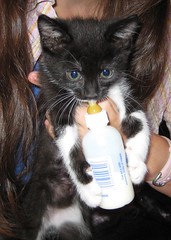
What to watch for and be careful of: While you’re feeding, you mostly just want to watch that your kitten isn’t aspirating, and that she’s latching on and getting her fill. 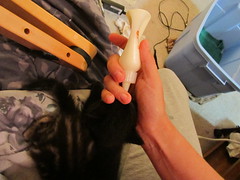 It’s actually better to be slightly underfed than overfed. Overfed babies can develop diarrhea which can become fatal pretty quickly from dehydration. Most of the time a kitten will latch on (once they have the hang of it) and get a good fast slurp down (I LOVE when they have such great suction that they collapse the bottle like in the picture here, or make the plunger in the syringe move on its own!), and after a quick burping and pottying, be ready to go back to sleep. Unless it’s your late night feed, in which case they will fuss about and refuse to latch, worry you silly, and FINALLY concede to taking in a measly 1-2 cc, making you wonder what you got yourself into. Yeah, that’s normal, try not to worry TOO much, as long as the rest of the feeds go okay.
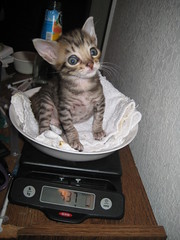 Kittens should approximately double their weight in the first week to ten days of life, with an average weight gain of 10 grams per day. If you’re charting, it’s going to be easy to spot things like weight gain, or lack thereof, more than a day or two without pooping, a large change in poop consistency, or a drop in feeding amounts.
Aftercare: Baby kittens need burping just like human babies. It’s pretty simple – just a firm but gentle tap with one finger on their back, and usually a little gasp of burp will come out. If it doesn’t after a little tapping, you can let it go until next time. Some kittens don’t end up needing it. Always worth a try, though. Gas bubbles are no fun in tiny intestines! You should also potty your kitten after feeding them, so they have the best chance of staying clean and dry in their nest until the next feed. Speaking of their nest, check it and if it needs a new towel, take care of that before putting the baby back to sleep.
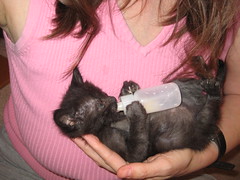
Naughty Kitten Eating the Wrong Way!







18 Responses to Formula Feeding